“Why LIC Is Rethinking Real Estate Now—and What a REIT-Like Model Could Mean”
Life Insurance Corporation of India — Real Estate Portfolio, Strategy & REIT Potential
Life Insurance Corporation of India — Real Estate Portfolio, Strategy & REIT Potential
1. Why LIC’s Real Estate Matters Now
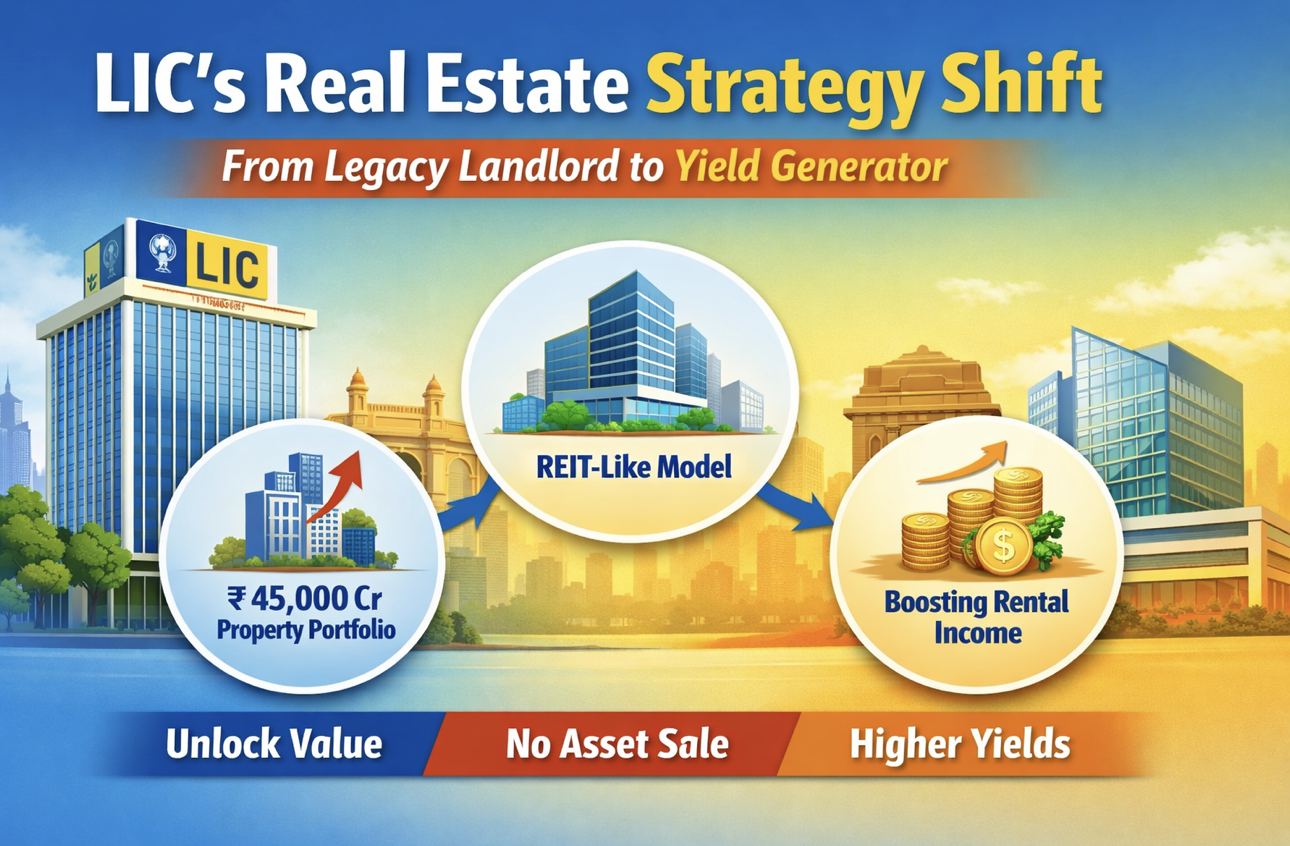
LIC is India’s largest institutional landlord by footprint, but historically its real estate has been: Conservatively valued, poorly monetised relative to market potential, treated as a balance-sheet stabiliser, not a growth lever. The post-revaluation book value of ~?16,000 Cr versus market value of ~?45,000 Cr exposed a latent value gap of ~?29,000 Cr, prompting a strategic rethink without triggering asset sales.
2. Major LIC Real Estate Assets — What & Where LIC owns 1,300+ properties across India, largely acquired between the 1950s and 1980s.
A. Mumbai. Offices, heritage buildings, Highest rental arbitrage (Nariman Point, BKC & Lower Parel)
Delhi Offices, institutional Govt & PSU tenants (premium CBD offices, Connaught Place)
Kolkata Offices, mixed-use Legacy holdings (Park Street)
Chennai Offices Stable PSU tenancy (Grade A Legacy Stock, Anna Salai)
Bengaluru Offices IT corridor exposure
Hyderabad Offices Financial District
Ahmedabad Offices PSU &
Govt Pune Office
LIC does not publicly disclose a property-wise list due to security and valuation sensitivity.
3. Property Types — What LIC Actually Owns
Commercial Properties 65–70%
Residential (staff/legacy) 15–20%
Land parcels (vacant / under-utilised) 10–15%
Others (guest houses, institutional) <5%
Critical insight: LIC’s portfolio is office-heavy, making it the ideal asset class for REITs.
4. Are These Properties Rented?
Occupancy Reality Overall rented portfolio:
~85–90% Self-occupied (LIC offices):
~10–15% Tenant, Profile: Central & state government PSUs, banks, regulators, Large corporates
Rental Yield (Estimated) Legacy rents: 2–3%
Market potential: 6–8% (post reset/redevelopment)
This yield gap is the single biggest trigger for monetisation thinking.
5. Why LIC Is Thinking About This Now
A. Structural Triggers
1. Post-IPO transparency pressure
2. Embedded Value scrutiny
3. SEBI & market push for capital efficiency
4. Government disinvestment roadmap (non-sale-based)
B. Strategic Logic LIC cannot:
Dump assets → political + market shock Raise premiums endlessly → policyholder backlash
LIC can: Unlock income without selling Re-rate assets through structure Improve ROA quietly
Hence: REIT-like models.
6. REIT-Like Model — How Likely Is It?
Probability Assessment Scenario Likelihood
Full-fledged listed REIT - Medium
Private / Govt-sponsored REIT - High
Platform with CPSEs - Very High
Asset-specific REIT (CBD offices) - High
Why “REIT-Like” and Not Straight REIT?
Legacy tenancy laws Heritage buildings Below-market rentals Political optics of “selling national assets” LIC will likely seed assets rather than divest ownership.
7. Will LIC Do It Alone or With Others?
Most Likely Structure LIC + Other CPSE landlords SBI PSU banks Port trusts Railways land arms
This aligns with: National Monetisation Pipeline (NMP), CPSE asset recycling philosophy, NITI Aayog’s “brownfield monetisation” thinking, LIC becomes: Anchor sponsor + asset aggregator
8. What Investors & Stakeholders Gain
A. LIC Shareholders Higher rental income Better valuation multiple Lower balance-sheet drag
B. Policyholders Stronger surplus Better solvency margins Reduced premium pressure
C. Capital Markets Large, sovereign-backed REIT Stable yield instrument Pension & insurance friendly product
9. What the Government Gains Strategic Wins
1. Non-tax revenue without privatisation
2. Higher LIC dividends
3. Cleaner PSU balance sheets
4. Capital market deepening
5. Urban redevelopment catalyst
Policy Alignment Budget speeches on asset recycling NITI Aayog’s monetisation framework Infrastructure-led growth narrative Bottom Line — Strategic Read
LIC is repositioning real estate from a sleeping balance-sheet asset to a steady income engine, without triggering asset sales or political risk.
A REIT-like structure is not a question of if, but how and when. Most likely outcome: a sovereign-anchored, CPSE-backed commercial REIT platform—with LIC at the centre.