From Gridlock to Skyway: How Air Taxis Could Quietly Redraw NCR’s Urban & Real-Estate Map
Why NCR’s Air Taxi Proposal Is Not About Flying — It’s About Repricing Time
1?? Executive Snapshot (For the Skimmers)
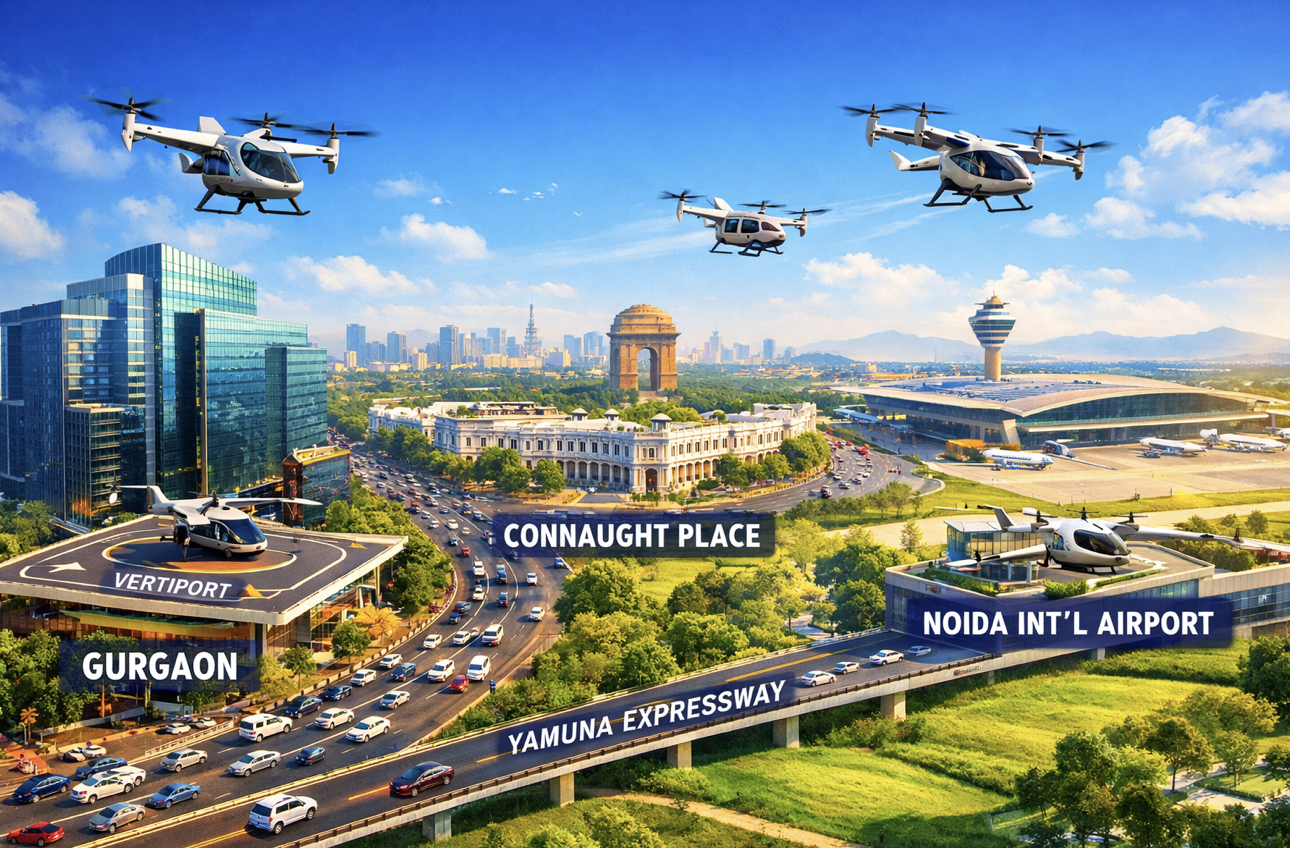
What’s being discussed: Air taxis between Gurgaon, Connaught Place & Noida International Airport
Why it matters: Commute time collapses → geography reshuffles → real estate reprices
Who should care: Real estate investors, Infrastructure planners Corporations eyeing airport-led growth corridors
This is not: A sci-fi mobility story
This is: A land-value and accessibility story
2?? The Real Problem (That Roads Can’t Solve)
Let’s be honest. Delhi-NCR doesn’t suffer from a lack of infrastructure.
It suffers from diminishing returns on ground infrastructure.
Every new road fills up. Every flyover shifts congestion, not removes it. Time—not distance—is the real bottleneck
When: Gurgaon → CP = 90 minutes
CP → Jewar (future airport) = unpredictable
You don’t have a mobility problem.
You have an economic friction problem.
3?? The Proposal (Stripped of the Hype)
The air taxi idea is simple when you remove the buzzwords: “What if premium, time-sensitive movement happens above the city instead of through it?”
Key attributes: Electric vertical take-off aircraft (quiet, short-range)
Rooftop or compact vertiports, point-to-point, not hub-and-spoke
This is not mass transit. It’s time arbitrage.
4?? Why This Is Credible (Not Speculative)
This isn’t a lone think-tank fantasy.
India’s largest aviation group is already aligned with a global eVTOL manufacturer Certification pathways are being discussed, not imagined Rooftop vertiports are already part of global building codes elsewhere
Most importantly: This exact playbook is being tested globally—right now.
5?? Global Precedent Check (Fast, Honest)
What’s working elsewhere:
Dubai: Treating air taxis as urban infrastructure, not experiments
China: Regulated first, commercialised later — but decisively
Japan: Public demos before public adoption
Europe: Infrastructure ahead of regulation (slower, but structured)
One pattern is clear: Where governments lead, air taxis move from demo to deployment.
6?? The Yamuna Expressway Angle (Where This Gets Serious)
Here’s the part most people miss.
The Yamuna Expressway is not a suburb.
It is becoming airport-first geography.
Now imagine:
Jewar Airport ↔ Central Delhi in ~20 minutes (air + ground)
Jewar ↔ Gurgaon without road dependency
Executives landing internationally and reaching business zones without traffic risk
What happens next?
Land near airports stops being “far” Logistics, hospitality, and enterprise clusters accelerate. Commercial land starts pricing future accessibility, not current distance
This is exactly how: Dubai South Schiphol corridor Heathrow zones …re-rated over time
7?? What Changes in Real Estate (Very Practically)
If this ecosystem matures—even partially—expect: New premiums near vertiport-ready developments
Higher institutional interest in airport-adjacent commercial assets.
Shift in buyer psychology: “How fast can I get there?” replaces “How far is it?” This doesn’t replace expressways.
It redefines which locations matter most along them.
8?? Risk Register (Because This Isn’t a Fairy Tale)
Let’s be clear-eyed: Regulatory timelines can slip Costs will initially limit scale
Public acceptance takes time But remember:
Metros were once “too expensive”
Airports were once “too far”
Expressways were once “underutilised”
Infrastructure always looks unnecessary— until the city grows into it.
9?? Final Take (Why This Is Worth Watching)
This proposal is not about flying vehicles.
It’s about:
Compressing time Reordering accessibility Quietly shifting how land, work, and movement interact
For the Yamuna Expressway, already riding an airport-led wave, Air taxis could become the next invisible multiplier.
Not loud. Not immediate. But structurally powerful.