

Gurugram’s 32nd Avenue Case: A Wake-Up Call for Commercial Property Investors
What Allegedly Went Wrong at 32nd Avenue
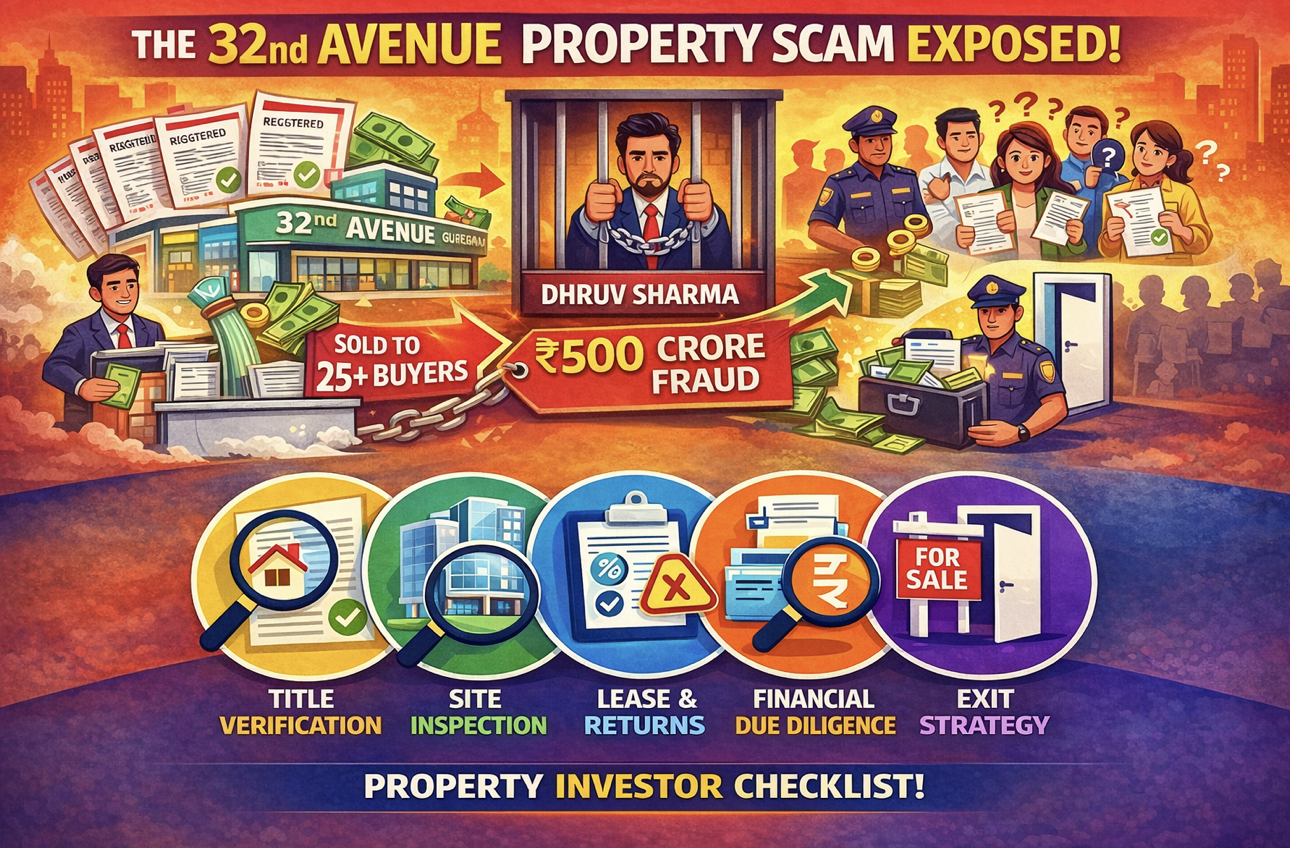
The arrest of Dhruv Dutt Sharma, CEO of 32nd Avenue, has sent shockwaves through India’s commercial real-estate market. What appeared to be a premium, high-yield investment opportunity in Gurugram has now emerged as one of the most serious alleged property frauds in recent years, with investigators estimating investor exposure of nearly ?500 crore.
At the heart of the case is a simple but devastating allegation: the same commercial unit was sold to multiple buyers, supported by complex layers of agreements, leasebacks, and corporate entities that blurred ownership and delayed detection.
Beyond the headlines, this episode is a masterclass in what investors must get right—especially when dealing with “assured return” commercial properties.
What Allegedly Went Wrong at 32nd Avenue According to police investigations and court filings:
A 3,000 sq ft commercial floor was allegedly sold to over 25 buyers between 2021 and 2023.
Conveyance deeds were delayed or selectively executed, while leaseback arrangements were used to retain control of the space.
Investors were promised long-term leases (up to 30 years), fixed rentals, escalation clauses, and buyback options.
Rental payouts initially flowed, creating confidence—then stopped abruptly.
Multiple group entities were used, allegedly allowing fund diversion and opacity.
The result:
Dozens of investors with registered documents, but no precise, exclusive control over the same asset.
Five Non-Negotiable Checks Every Investor Must Do.
This case is not an outlier—it is a warning.
Here are five critical inspections every investor must complete before committing capital to similar properties.
1. Title & Exclusivity Check (Beyond the Sale Deed) A registered sale deed alone is not enough.
What to verify: Chain of title for at least 30 years. Whether the same unit/floor / undivided share has been sold earlier. Encumbrance certificate from the sub-registrar. Confirmation that no parallel agreements, POAs, or development rights exist. Investor mindset: If exclusivity is even slightly ambiguous, walk away.
2. Demarcation & Physical Possession Audit. In this case, many investors allegedly held “paper units” rather than physical units.
What to physically inspect: Clearly demarcated area with boundaries. Access rights, entry points, utilities. Ability to independently occupy or lease the space. Red flag: If the developer controls entry, locks, or access after sale, you don’t own the asset—you’re funding it.
3. Lease Structure Reality Check (Kill the ‘Assured Return’ Illusion) Assured returns are not rental income—they are developer liabilities.
What to scrutinise: Is the lease with a real third-party tenant or a group company? Is rent backed by tenant cash flows or promoter promises? What happens if leasing stops—do you get possession or excuses? Rule of thumb: If rent depends on the promoter’s balance sheet, treat it as credit risk, not real estate.
4. Corporate & Cash-Flow Due Diligence In the 32nd Avenue case, multiple entities allegedly blurred accountability.
Mandatory checks: Group structure and related-party transactions; MCA filings, charges, borrowings, defaults; GST, TDS, PF, ESI compliance; Litigation search across all group entities. Investor lens: Complex structures are delicate—but opacity is fatal.
5. Exit & Control Scenario Planning Most investors focus on entry yield, not exit control.
Ask blunt questions: Can you sell the unit independently tomorrow? Who signs the lease—owner or developer? If rentals stop, do you regain possession legally? Hard truth: An asset you cannot independently exit is not an investment—it’s a hostage situation.
The Bigger Takeaway: The 32nd Avenue episode is not just about one developer or one project. It highlights a structural issue in India’s commercial real-estate market:
When yield marketing outpaces legal clarity, risk multiplies silently. For serious investors, the lesson is clear: Prioritise ownership clarity over yield. Treat assured returns as risk capital, not fixed income. Allocate more to legal and forensic diligence than to brochures. In commercial real estate, boring due diligence is what protects exciting returns.