

India’s Co-working Boom: Big Growth, Real Profits, but REITs Still Look Unlikely
model
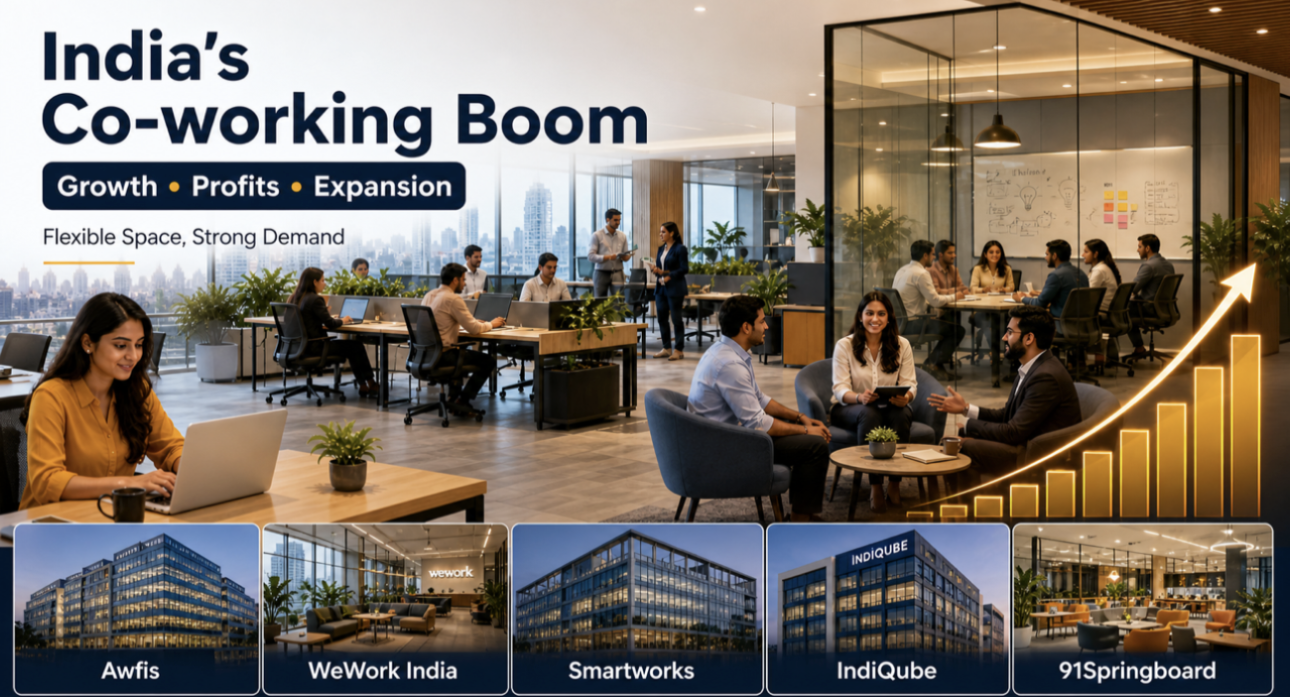
India’s office market is changing fast. A few years ago, co-working spaces were mostly seen as startup-friendly shared offices. Today, they are becoming an increasingly significant part of commercial real estate. The recent lease of 1.4 lakh sq ft by Bengaluru-based Concorde to BHIVE is another clear signal. Demand for flexible, managed, and ready-to-use office space is no longer limited to freelancers or small startups. Large companies, GCCs, mid-sized businesses and expanding teams are now using co-working and managed office spaces as a core part of their real estate strategy. This shift has helped several co-working operators scale rapidly across India. The biggest names today are Awfis, WeWork India, Smartworks, IndiQube and 91Springboard. BHIVE is also emerging strongly, especially in Bengaluru, and deserves attention because of its aggressive campus-style expansion. THE TOP PLAYERS BY SCALE Among the leading co-working companies in India, Awfis has one of the largest networks in terms of the number of centres. It operates across 18 cities with more than 230 centres and around 7.8 million sq ft of chargeable area. Awfis has built its business around an asset-light managed aggregation model, in which it partners with landlords rather than owning buildings. WeWork India has a smaller centre count than Awfis but a strong premium positioning. It operates more than 70 centres across major cities such as Bengaluru, Mumbai, Gurugram, Noida, Pune, Hyderabad, Chennai and Delhi. Its operational footprint is around 8.2 million sq ft. The company focuses heavily on Grade-A office assets, enterprise clients and premium flexible workspaces. Smartworks is one of the largest players by total area. It has crossed 10 million sq ft of operational portfolio and has a total portfolio of around 16.1 million sq ft across India and Singapore. Its model is more enterprise-led, with large campuses and managed office solutions for corporates. IndiQube has also scaled aggressively. It manages around 8.4 million sq ft across 115 properties and has a strong presence in Bengaluru. The company has focused on enterprise clients, GCCs and managed offices, supported by its technology-led workspace platform. 91Springboard is smaller in comparison but remains an important national co-working brand. It operates around 40 centres across eight cities, with approximately 1.5 million sq ft of workspace and around 30,000 desks. Its strategy is based on clusters, where multiple centres are located close to one another so clients can expand, downsize, or relocate more easily within the network. Then there is BHIVE, which is fast becoming a serious Bengaluru-led player. It operates more than 28 centres across Bengaluru and Mumbai, with around 1.8 million sq ft of workspace. Its focus is on large-format campus-style co-working and managed offices. The Concorde lease further strengthens this approach. DO THESE COMPANIES OWN THEIR OFFICE SPACES? This is the most important point from a real estate investor’s perspective. Most of India’s top co-working companies do not own the buildings they operate from. They generally lease space from developers, landlords or institutional office owners. Then they design, fit out, manage and monetise that space by selling desks, cabins, enterprise suites or managed office solutions. This is true for Awfis, WeWork India, Smartworks, IndiQube, 91Springboard and BHIVE. Their business is largely asset-light. That means they are not buying office buildings. They are creating value through design, operations, technology, leasing flexibility, hospitality and client management. This model helps them grow faster because they do not need to deploy massive capital into land or building ownership. But it also means they carry lease obligations and must maintain strong occupancy to remain profitable. WHY REITs ARE UNLIKELY FOR CO-WORKING OPERATORS There is considerable market curiosity about whether co-working companies can enter the REIT space. The simple answer is: not in their current form. A REIT is primarily a vehicle for owning income-generating real estate. In India, a REIT needs to hold completed, rent-yielding real estate assets. The top co-working companies, however, are mostly operators and leaseholders. They do not own enough commercial real estate to qualify as REIT-style platforms. So, while their centres may be located inside buildings owned by REITs or large developers, the co-working companies themselves are not natural REIT candidates. For example, WeWork India may operate from properties owned by major developers or institutional landlords. Smartworks may lease large campuses. BHIVE may take entire buildings on lease. But the underlying asset still belongs to the landlord, not the co-working company. Therefore, a REIT route appears unlikely for these companies unless they completely change their business model and start owning commercial assets at scale. That would defeat the purpose of their current asset-light strategy. A more realistic path is this: co-working operators will continue to partner with REITs, developers and institutional landlords rather than become REITs themselves. HOW ARE THESE COMPANIES FUNDING EXPANSION? The sector is now moving from startup-style funding to capital-market funding. Awfis already went public through its IPO. That gives it access to public market capital and improves credibility with landlords and enterprise clients. WeWork India has also moved toward an IPO. With improving profitability and strong enterprise demand, a public listing allows the company to raise capital, improve brand trust and support expansion. Smartworks has also entered the listed space and is using its scale, contracted revenue and enterprise client base to support growth. Its large operational footprint gives it greater visibility than smaller operators. IndiQube launched a ?700 crore IPO, with proceeds planned for new centres, debt repayment and general corporate purposes. This is a clear sign that flexible workspace companies are now being evaluated like mainstream commercial real estate operating businesses. BHIVE is planning a pre-IPO funding round and has publicly indicated its ambition to list in the future. It is looking at a mix of equity and debt to support expansion into new markets. 91Springboard has raised venture capital in the past and is exploring additional growth capital. Since it is smaller than the listed players, it may continue relying on private investors before considering any public market route. In short, these companies are not choosing REITs for funding. They are choosing IPOs, private equity, debt, landlord partnerships and revenue-sharing models. WHICH COMPANIES ARE PROFITABLE? This is where the sector has become more interesting. Earlier, co-working businesses were often questioned for high lease costs, high fit-out costs and uncertain occupancy. But FY25–FY26 data shows that several operators are now moving into profitability. WeWork India has reported profitable quarters, supported by strong revenue, high occupancy and premium enterprise demand. Smartworks has also turned profitable, reporting its first full-year profit in FY26 after losses in the previous year. IndiQube has reported PAT-positive numbers under IGAAP accounting and has paid income tax in FY24 and FY25. Awfis has improved significantly after its IPO and reported profit in H1 FY26, although it had a history of losses before reaching this stage. BHIVE is also profitable, though on a smaller scale than the larger national players. 91Springboard has reportedly been profitable since FY24 and expects strong revenue growth. This profitability trend is important. It shows that the co-working model is no longer just about rapid expansion. The stronger players are now focusing on occupancy, enterprise clients, managed offices, cost discipline and long-term revenue visibility. WHAT IS DRIVING THE GROWTH? Four major factors are driving the growth. First, large companies want flexibility. Instead of signing long traditional leases and spending heavily on interiors, they prefer ready-to-use offices where they can scale up or down. Second, Global Capability Centres are expanding rapidly in India. Many GCCs want high-quality offices but also want speed and flexibility. Managed office operators are filling that gap. Third, startups and mid-sized businesses still prefer co-working because it reduces upfront capital expenditure. Fourth, landlords are also becoming more open to partnerships. A strong co-working operator can activate large office spaces faster and bring multiple clients into a building. This creates a win-win model when executed well. The landlord gets occupancy. The operator gets scale. The client gets flexibility. THE KEY RISK The biggest risk is still the same: lease liability. Co-working companies must pay landlords whether their spaces are full or not. If occupancy drops, margins can come under pressure quickly. That is why the stronger operators are now focusing on enterprise clients, longer contracts and managed offices rather than only hot desks and startup memberships. Companies with better occupancy, strong brand recall, disciplined expansion and landlord-friendly structures will survive and grow. Companies expanding unquestioningly may struggle. FINAL VIEW India’s co-working sector has matured. It is no longer just about trendy shared offices. It has become a serious commercial real estate operating model. The top players are scaling fast, attracting capital and moving toward profitability. However, they are not likely to become REITs because they do not own the underlying real estate. Their strength lies in operations, design, client acquisition, technology and flexible leasing. The future funding route for these companies will be IPOs, debt, private equity and strategic landlord partnerships. For developers and landlords, this is a major opportunity. Co-working operators are becoming strong demand aggregators. For occupiers, they provide speed and flexibility. For investors, the real opportunity is not in expecting these companies to become REITs, but in understanding which operators can convert scale into sustainable profits. The winners will be those who balance growth with discipline. In Indian commercial real estate, the real value will be created.