

Registered Wills in India: Why Property Still Gets Stuck in Court — and What Actually Works
A registered will feels like closure. The family believes the paperwork is complete. The property should pass smoothly. Yet, across India, thousands of inheritance disputes reach court every year—even when the will is registered
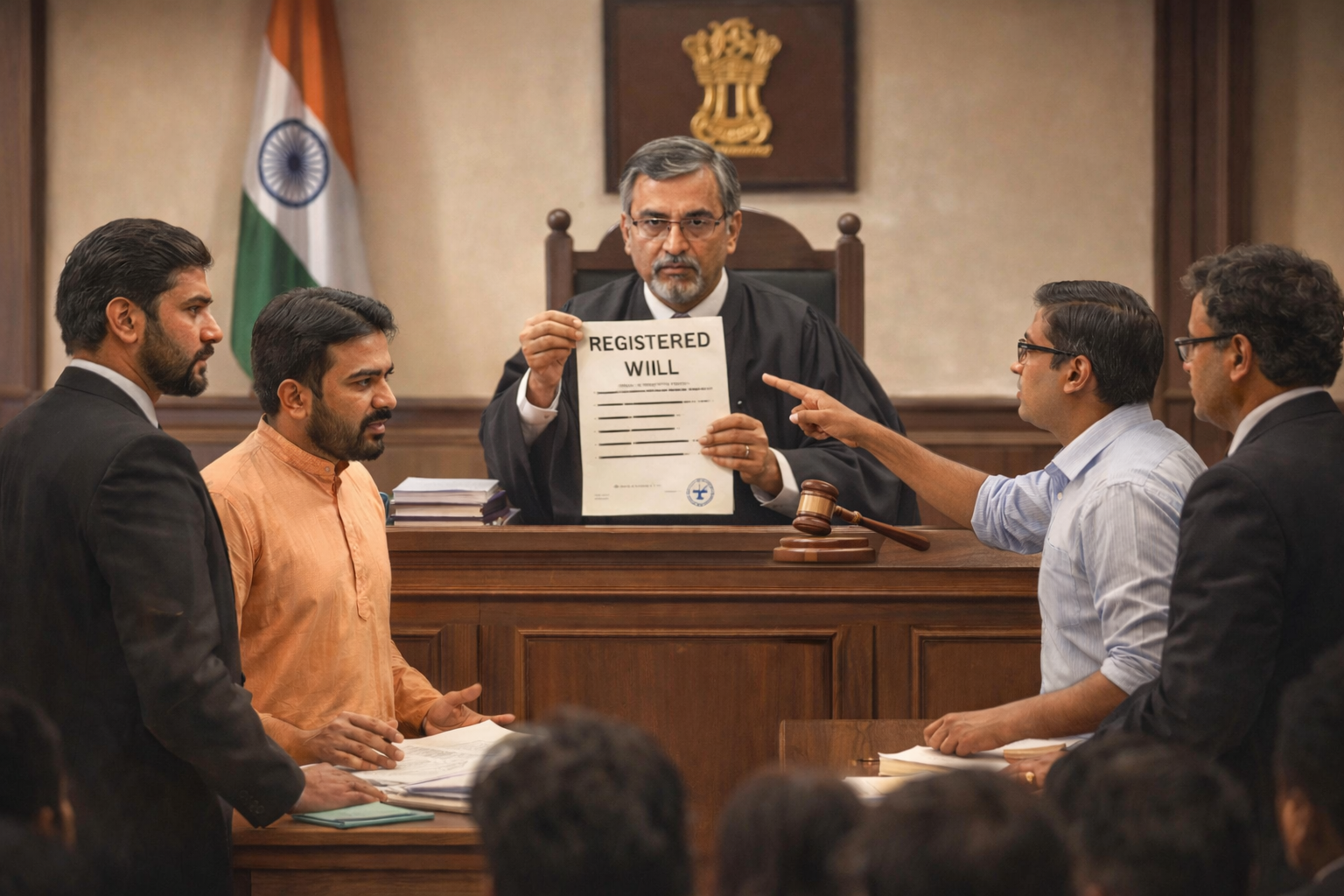
A registered will feels like closure. The family believes the paperwork is complete. The property should pass smoothly.
Yet, across India, thousands of inheritance disputes reach court every year—even when the will is registered.
This article examines why that happens, what the law actually says, how mutation works, the scale of court backlogs, and—most importantly—what individuals (especially NRIs) can do to avoid financial loss.
1. The Core Reality:
A Registered Will Is Not a Transfer Document Under the Indian Succession Act, 1925:
• A will takes effect only upon the testator’s death.
• It must be signed by the testator.
• It must be attested by at least two witnesses (Section 63).
Registration of a will is optional under the Registration Act, 1908.
Here is the legal catch:
Even if a will is registered, it must still be proved in court if challenged. Under the Bharatiya Sakshya Adhiniyam, 2023:
• At least one attesting witness must testify (if available).
• The “registration exception” that relaxes proof for other documents does not apply to wills.
That is the structural reason litigation begins.
2. Why Disputes Arise
Even After Registration Courts frequently see disputes involving:
• Allegations of coercion or undue influence
• Claims that the testator lacked mental capacity
• Existence of a later will
• Forgery allegations
• Exclusion of natural heirs
The Supreme Court of India has repeatedly held that: Registration does not dispense with proof of a will.
If “suspicious circumstances” exist, the burden on the will-holder becomes heavier.
3. Mutation:
Necessary but Not Ownership
After death, the will-holder usually applies for mutation.
Mutation:
• Updates revenue/municipal records
• Allows payment of tax
• Enables administrative control
However, courts consistently hold that mutation does not confer title.
Revenue officers cannot conduct a full trial to decide the validity of a disputed will.
That is for civil courts.
So even after mutation, a rival heir can file:
• A partition suit
• A declaration suit
• An injunction
And the matter enters the judicial pipeline.
4. The Scale of the Problem: Court Backlogs
As of February 2026:
• District & Subordinate Courts: ~4.84 crore pending cases
• High Courts: ~63 lakh pending cases
• Supreme Court: ~92,000 pending cases
Some of the highest High Court backlogs include:
• Allahabad High Court
• Rajasthan High Court
• Bombay High Court
• Madras High Court
And at the district level:
• Uttar Pradesh
• Maharashtra
• West Bengal
Property and succession disputes form a significant portion of civil litigation in these states.
This explains why inheritance litigation can last for years —sometimes decades.
5. The NRI Risk Factor
NRIs face elevated exposure because:
• They are geographically absent
• Relatives may suppress information
• Forged POAs are used
• Deaths are not immediately communicated
• Mutation happens quietly
• Fraudulent sales occur before detection
Recent fraud patterns show impersonation of deceased owners and illegal property transfers.
The Supreme Court of India has clarified that a Power of Attorney does not transfer ownership.
It is merely an agency.
Yet misuse continues.
For NRIs, the loss is often discovered too late.
6. Legal Requirements to Get Property Mutated in the Will-Holder’s Name
Though procedures vary by state, typically required documents include:
• Death certificate
• Original or certified copy of the registered will
• Identity proof
• Relationship proof
• Affidavit and indemnity bond
• Tax receipts
• Sometimes NOCs from other heirs
If the will is unregistered, authorities may insist on heir affidavits or even a court order.
If the will is disputed, mutation may be stalled pending a civil court decision.
7. The Easiest and Most Effective Way Out (For Individuals)
A. Before Death (Planning Stage)
1. Ensure two reliable independent witnesses.
2. Consider video recording the execution (optional but helpful).
3. Obtain a medical certificate for elderly testators.
4. Keep the original safely deposited (Registrar deposit option available).
5. Inform the executor clearly.
B. Immediately After Death
1. Secure the original will.
2. Gather medical and execution evidence.
3. Apply for mutation quickly.
4. If dispute risk exists, file probate or a civil declaration proactively.
C. For NRIs (Critical Safeguards)
1. Use narrow, transaction-specific POAs only.
2. Activate SMS/email property alerts wherever available.
3. Monitor land records periodically.
4. Avoid giving general powers to extended relatives.
5. Act immediately if suspicious activity appears (injunction first, arguments later).
Delay is the biggest financial mistake.
8. What the Judiciary and Government Should Do
1. National Digital Will Registry A secure post-death retrieval system to prevent suppression and forgery.
2. Death-Linked Automatic Notification
When death is registered, an automatic alert is sent to:
• Recorded heirs
• Overseas contacts
• Registered email/phone
3. Mandatory Owner Alerts
Any mutation or registration attempt should trigger notification to the recorded owner/heirs.
4. Succession Fast-Track Courts Uncontested wills should receive summary validation orders within fixed timelines.
5. Land Records–Court Integration Civil decrees must automatically update land records to prevent parallel disputes.
6. Strict POA Controls Digitally traceable POA registration with mandatory biometric confirmation.
9. Structural Reform Roadmap
Short-Term:
• Digital alerts
• Standardised mutation protocols
• Mandatory notice periods
Medium-Term:
• Digital will vault
• e-Court and land record integration
Long-Term:
• Complete land titling reform
• Presumptive title system instead of the revenue record model
Final Reality Check: A registered will is not a shield. It is the starting document — not the final solution.
Property disputes persist because:
• The proof burden is high
• Mutation is not a title
• Court backlogs are massive
• Family conflicts are emotional and unpredictable
For individuals:
Prevention is 10 times cheaper than litigation.
For NRIs: Monitoring is survival.
For the system: Digitisation and integration are the only scalable exit from inheritance chaos.
Until structural reform is implemented, inheritance in India will remain legally valid — but procedurally fragile.