

Should We Live on Plots Instead of Flats?
What India’s Seismic-Zone Debate Means for Homebuyers and Real Estate In the past few months, an unusual debate has surfaced in India’s scientific and policy circles—one that goes far beyond geology. It raises a question many homebuyers are now asking
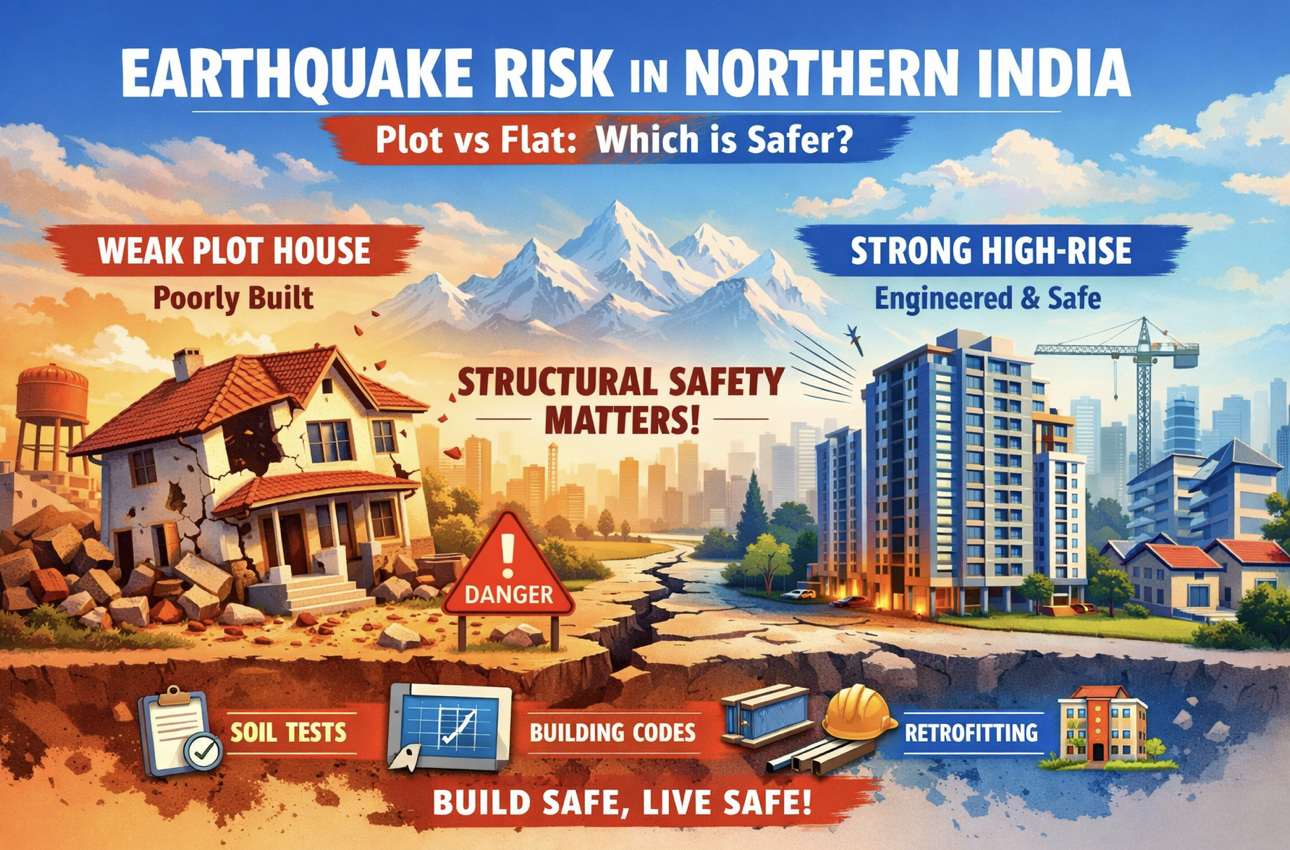
Is it safer to live in plots (independent houses) rather than flats in high-rise buildings?
The trigger for this debate was the new seismic hazard assessment released under India’s Earthquake Design Code 2025, which briefly reshaped how scientists and planners view earthquake risk in the country.
The findings were striking—and controversial.
The Scientific Warning: India Is More Earthquake-Prone Than We Thought
India sits on the Indian tectonic plate, which continuously pushes against the Eurasian plate at a rate of roughly 4–5 cm per year.
This geological collision is responsible for the formation of the Himalayas—but it also makes large parts of the subcontinent vulnerable to earthquakes.
Historically, seismic maps suggested that about 59% of India’s landmass falls within earthquake-prone regions. However, the 2025 revision of the Earthquake Design Code introduced a more advanced scientific approach called Probabilistic Seismic Hazard Assessment (PSHA).
The new findings revealed that: 61 % of India’s landmass lies in moderate to high earthquake hazard zones Around 75–80 % of India’s population lives in seismically active areas
The entire 2,500 km Himalayan arc—from Jammu & Kashmir to Arunachal Pradesh—should be classified under a new highest-risk category: Zone VI.
This revision also warned that some sections of the Himalayas may be capable of producing magnitude-8 or larger earthquakes in the future.
For scientists, the message was clear: India’s seismic exposure had been underestimated for decades.
The Government Rollback That Sparked the Debate Despite the scientific backing, the revised seismic map did not last long. Within months of its release, the Bureau of Indian Standards (BIS) withdrew the updated seismic design code after the Ministry of Housing and Urban Affairs raised concerns.
The main reason: cost. According to estimates, implementing the stricter earthquake-resistant standards could have increased: Residential construction costs by 20 % or more Infrastructure project costs by up to 50 % Developers warned that the changes could disrupt ongoing projects and inflate housing prices nationwide.
Scientists, however, strongly criticised the rollback. Several geoscientists called it a missed opportunity to improve India’s earthquake preparedness, especially in the Himalayan and Indo-Gangetic regions where millions of people live.
Why Northern India Is Particularly Vulnerable The risk is especially significant for North India, where some of the country’s fastest-growing cities are located.
Areas falling in high seismic zones include: Jammu & Kashmir Himachal Pradesh Uttarakhand Parts of Bihar and North Bengal Delhi-NCR Northern Uttar Pradesh These regions lie close to the Main Himalayan Thrust, one of the world’s most active geological fault systems.
Cities like Delhi, Dehradun, Chandigarh, Srinagar, and parts of the NCR fall under Zone IV or higher risk categories.
Experts stress that there is no completely safe seismic zone in India.
The real danger comes not from earthquakes themselves—but from weak buildings.
The Plot vs Flat Question
What Science Actually Says After every earthquake tremor felt in Delhi-NCR, a familiar argument resurfaces: “Independent houses must be safer than high-rise buildings.”
However, engineering research tells a different story.
Structural design matters more than building height Experts emphasise that earthquakes rarely kill people—collapsed buildings do.
A properly engineered building—whether a tower or a bungalow—can withstand seismic forces if built according to structural codes.
Modern high-rise buildings are designed to move.
In fact, engineers explain that swaying during tremors is a sign of structural safety, not danger.
Modern towers include: Shear walls Seismic dampers Flexible structural frames
These technologies allow buildings to absorb earthquake energy and safely redistribute forces. Many modern structures can withstand earthquakes of magnitude 7.5 or higher. Independent houses often escape engineering scrutiny.
Ironically, single-plot homes may sometimes be less safe because they are often constructed without structural engineering supervision. Unlike large residential projects, independent houses may not follow detailed soil studies or structural calculations.
The Real Problem: Weak Construction and Poor Compliance
India already has strong earthquake-resistant building standards under the National Building Code and BIS guidelines.
The challenge is implementation.
Urban growth across many cities has been rapid and unregulated, resulting in buildings constructed with: poor structural design low-quality materials deviations from approved plans
Experts warn that many older buildings—especially those built before the 2002 code revision after the Bhuj earthquake—may not meet modern safety standards.
Retrofitting such buildings could cost around 20 % of the original construction cost, but this investment could dramatically improve safety.
What Homebuyers Should Check Before Buying a Property The recent debate has highlighted an important lesson for buyers.
Instead of asking “plot or flat?”, the real question should be: “Is the structure earthquake-safe?”
Before buying a property, experts recommend checking: Structural designer details Soil investigation report Compliance with IS building codes (IS 1893, IS 13920, etc.)
Earthquake-resistance category of the building Quality of materials and construction supervision In India, buildings are classified into: Operational Immediate Occupancy Life Safety Collapse Prevention Higher categories offer better post-earthquake usability but may cost slightly more.
What This Means for the Real Estate Market
The seismic-zonation debate could shape the future of real estate in multiple ways.
Construction costs may rise.
Stricter seismic standards could increase construction costs by 15–30 % in high-risk areas.
Insurance premiums could increase Properties in Zones V and VI may attract higher insurance costs.
Buyers may demand transparency.
Developers may need to provide detailed structural information and safety certifications.
Retrofitting will become a major industry Older housing societies may require seismic evaluations and strengthening.
A Bigger Lesson
India’s Urban Future India’s cities are expanding rapidly.
The debate around the seismic map is not just about construction costs—it is about long-term urban resilience.
Countries like Japan and Chile have shown that strong building codes and strict enforcement can drastically reduce earthquake casualties.
For India, the challenge is not only to build more homes, but to build safer homes.
Final Thought
Living on a plot does not automatically make someone safer from earthquakes. Safety depends on engineering, design, and compliance with seismic standards.
A well-designed high-rise apartment can be safer than a poorly built independent house.
As India continues its massive urban expansion—especially in Northern India’s earthquake-prone regions—the real estate sector will need to move toward science-based construction and resilient planning. Only then can growth and safety coexist.