

The 5 All-Time Greatest Real Estate Books (And Why They Still Matter)
The 5 All-Time Greatest Real Estate Books (And Why They Still Matter)
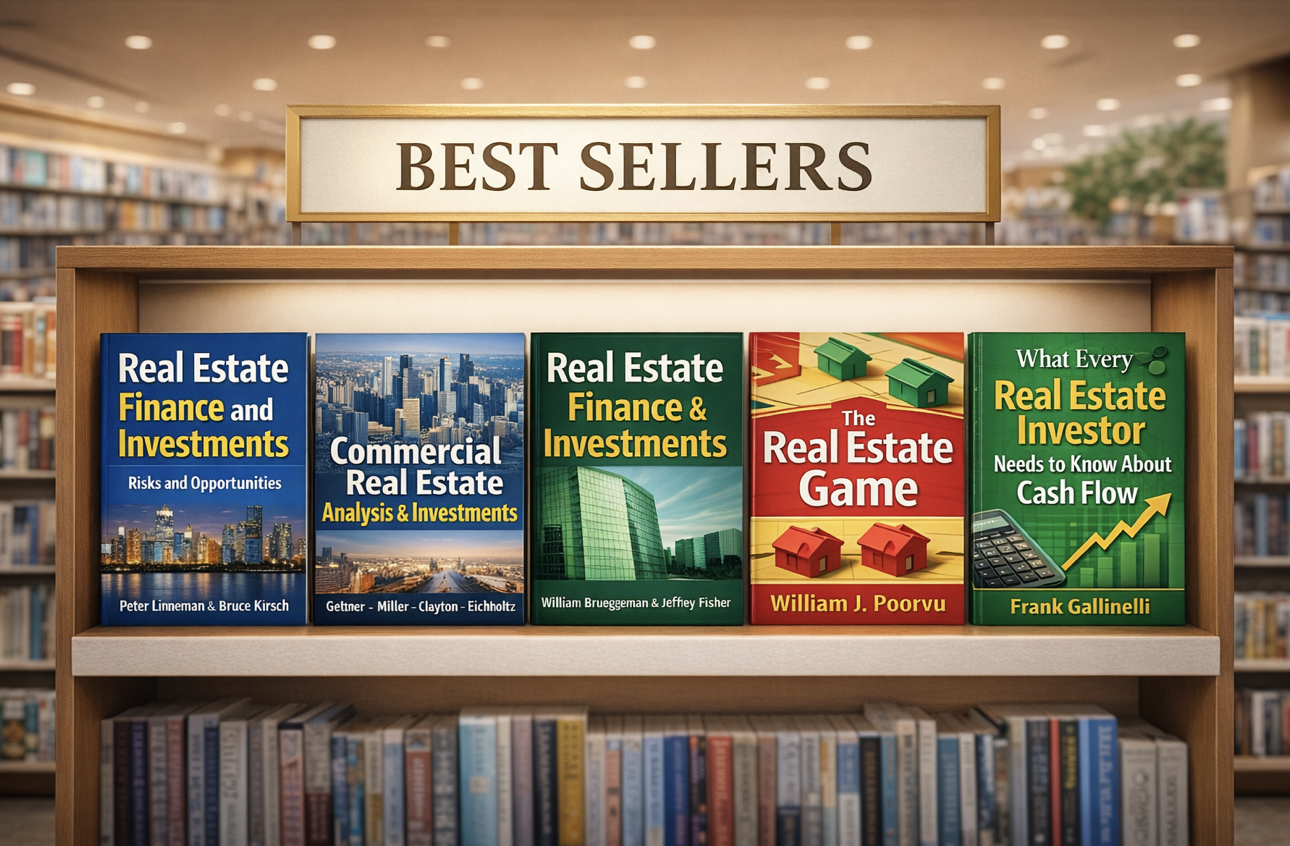
In a world flooded with “get rich quick” property guides and social-media investment hacks, very few real estate books stand the test of time.
The true classics do three things exceptionally well:
• They teach you how real estate actually works
• They build decision-making discipline
• They remain relevant across cycles—booms, crashes, and everything in between
After reviewing academic syllabi, industry reading lists, commercial real estate forums, MBA programs, investment blogs, and practitioner recommendations worldwide, five books consistently rise to the top.
These are not trendy reads.
They are foundational frameworks.
1. Real Estate Finance and Investments: Risks and Opportunities Peter Linneman & Bruce Kirsch
Often referred to as the “Blue Bible of Real Estate.”
This book is used in over 125 universities and by leading global real estate firms. It bridges academic rigour with real-world investing.
Why It’s Essential:
• Covers real estate cycles, risk, debt, equity, and capital markets
• Explains how property is priced relative to other asset classes
• Emphasises surviving downturns—not just thriving in booms
• Combines case studies with deep analytical frameworks
Who Should Read It:
Anyone serious about institutional-grade real estate thinking—developers,
PE professionals,
large-scale investors, and advanced students.
Bottom line:
If you want to understand real estate at a structural level—not just transactional—this is the gold standard.
2. Commercial Real Estate Analysis and Investments David Geltner, Norman Miller, Jim Clayton & Piet Eichholtz
This is the academic backbone of commercial real estate analysis.
It explains something most retail investors never fully grasp:
The difference between the space market and the asset market.
What It Teaches:
• How rental demand drives cash flow
• How capital markets determine pricing
• Discounted cash flow (DCF)
• Cap rate logic
• Risk-adjusted valuation
Why It Matters:
It connects macroeconomics, finance, and property fundamentals in one coherent framework.
If Linneman is the “Blue Bible,” this is the institutional underwriting playbook.
3. Real Estate Finance and Investments William Brueggeman & Jeffrey Fisher
A cornerstone textbook in real estate finance for over 25 years.
This book simplifies complex financial concepts without oversimplifying them.
Core Strengths:
• Time value of money
• Leverage mechanics
• Mortgage structures
• Risk-return modelling
• Taxation impact
It is structured like a course—but readable like a practitioner manual.
Why It’s Timeless:
Because real estate is ultimately a financial business.
Understanding debt and capital structures separates amateurs from professionals.
4. The Real Estate Game William J. Poorvu
This is where spreadsheets meet psychology.
Unlike heavy textbooks, this book teaches through stories and real-life deal examples.
The Big Lessons:
• Discipline matters more than excitement
• A bad deal in a great market is still a bad deal
• Models are only as good as their assumptions
• Real estate is about people, not just numbers
Poorvu emphasises something most analytical books ignore:
Real estate is a human business wrapped in a financial structure.
This book sharpens judgment—not just calculation skills.
5. What Every Real Estate Investor Needs to Know About Cash Flow Frank Gallinelli
This is the definitive guide to understanding real estate metrics.
If you don’t fully understand:
• Net Operating Income (NOI)
• Cap Rate
• Internal Rate of Return (IRR)
• Debt Coverage Ratio (DCR) —This book fixes that.
Why It’s Critical:
It removes emotional investing and replaces it with measurable analysis.
Clear. Practical. Applicable immediately.
For many investors, this is the first book that makes real estate numbers finally “click.”
Why These Five Stand Above the Rest.
There are hundreds of popular real estate books.
Many are motivational.
Many are tactical.
Some are trendy.
But these five books:
• Shape academic curricula
• Influence institutional underwriting
• Are cited by professors and private equity professionals
• Remain relevant decades after publication
They don’t promise overnight wealth.
They build enduring capability.